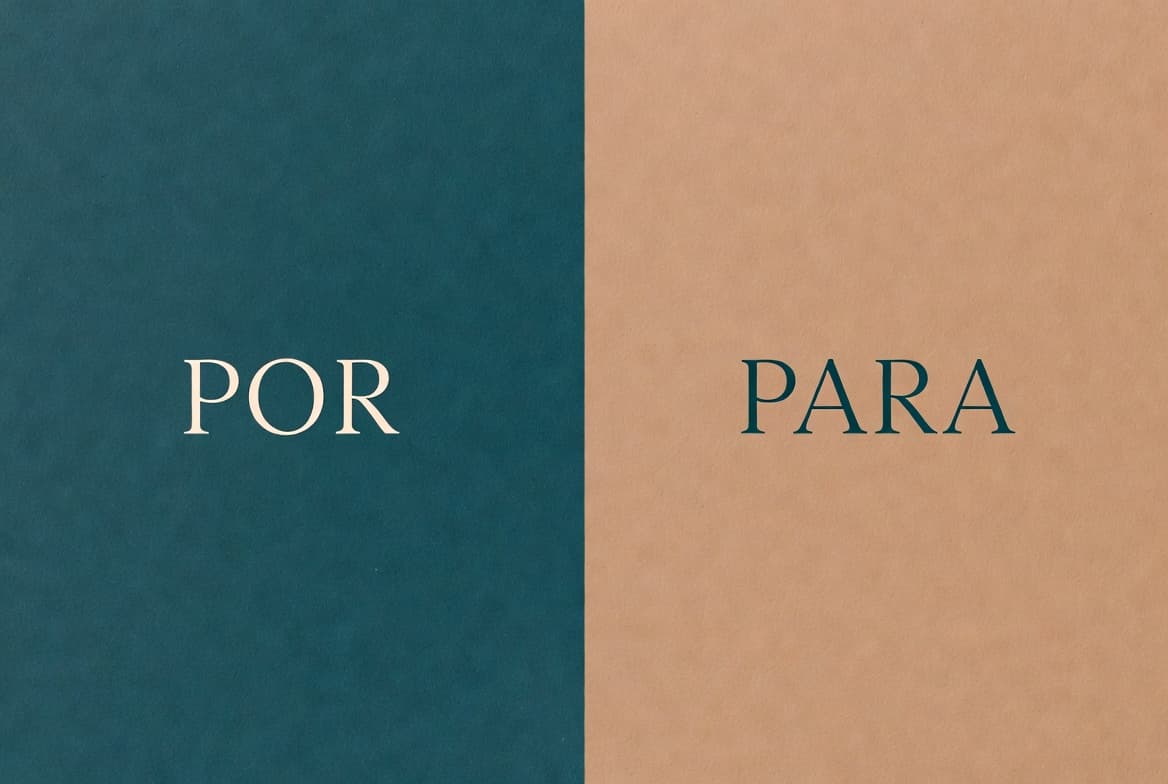
Por vs Para: The Ultimate Guide (with Examples and Tricks)
"Por" and "para" are two of the most confusing prepositions for Spanish learners. They both can mean "for" in English, but they are used very differently. Here’s the clearest guide to finally master them.
Quick Summary Table
| Use Case | Por | Para |
|---|---|---|
| Reason / Cause | Por | — |
| Purpose / Goal | — | Para |
| Time duration | Por (for a period of time) | — |
| Deadline | — | Para (by / for a date) |
| Movement through a place | Por | — |
| Recipient / Beneficiary | — | Para |
| Exchange / Price | Por | — |
| Opinion | Por (in my opinion) | — |
Detailed Rules with Examples
When to use POR
- Reason / Cause: Lo hice por ti. (I did it because of you.)
- Duration of time: Viví en Madrid por 3 años.
- Movement through: Caminé por el parque.
- Exchange / Price: Lo compré por 20 euros.
- Means / Method: Te lo envío por correo.
- Opinion: Por mí, es una buena idea.
When to use PARA
- Purpose / Goal: Estudio para aprender español.
- Deadline: Necesito el informe para el viernes.
- Recipient: Este regalo es para mi madre.
- Intended for: Esta comida es para la fiesta.
- In order to: Trabajo duro para mejorar.
Common Mistakes
Wrong: Voy por España el mes que viene.
Correct: Voy a España el mes que viene.
Wrong: Lo hago para ti (if meaning "because of you").
Correct: Lo hago por ti.
Practical Tricks
- POR = cause, duration, movement, exchange.
- PARA = purpose, deadline, recipient, destination.
If you can replace it with “because of” or “through” → usually por.
If you can replace it with “in order to” or “for the purpose of” → usually para.
Continue lendo

Shadowing in Spanish: How to Improve Your Pronunciation, Listening & Fluency Fast (Step-by-Step Guide)
Struggling to sound natural in Spanish or understand fast speech? Discover the shadowing technique used by interpreters and successful learners. Step-by-step guide + best resources for 2026 + how to combine it with Bocabla for faster results.

Bocabla is now live on Product Hunt 🚀
Bocabla: Master Spanish is now live on Product Hunt! Learn Spanish smarter with Smart Review (FSRS), achieving 88%+ retention with 20-30% less effort. Designed specifically for English speakers who want real conversational fluency.
Spanish Food & Restaurant Vocabulary: 50+ Essential Words and Phrases
Master Spanish food vocabulary with this fun storytelling guide. Learn 50+ words and phrases to order confidently, understand menus, and enjoy restaurants like a local in Spain and Latin America.